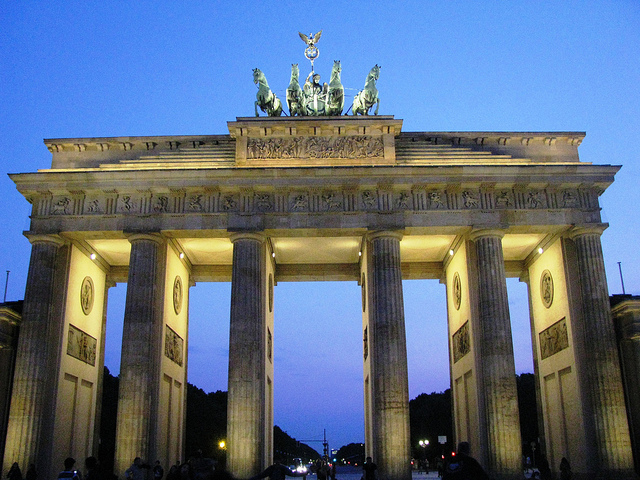
Reflections about Berlin
For many years I have been drawn to the south of Europe, to the Mediterranean area. The hot sun, the stunning landscapes, thousands of years of history and the magnificent architecture of southern European countries like Spain and Italy just always appealed to me. Recently I have become much more interested in other parts of Europe. Having been born in Austria, I grew up next to a series of former Eastern Bloc countries, and my trip to Prague in 2009 really opened up my eyes to other regions of Europe.
As a history buff, one city that has fascinated me for a long time is Berlin. I have a very personal connection with the Second World War as my father fought in it and I have always tried to learn about this turbulent and horrific period in European history. And what better place to learn about it than Berlin…
I had the good fortune to have visited Berlin for one day in August of 1989, three months before the Wall came down. Although I only spent a very short time in this fascinating city, I got to see the Western neon-lit consumer paradise of Kurfürstendamm and the drab grey monotony in East Berlin on the other side of Checkpoint Charlie. I still remember that I could “feel history” during my one day trip to Berlin in 1989. Naturally I was absolutely curious how Berlin had changed in the more than 20 years after German reunification.
Well, I wasn’t disappointed. Berlin sure has been one of my most interesting and fascinating travel experiences to date. During my four and a half days in Berlin I got to see many of the well-known tourist attractions: I got to ascend the magnificent dome of the Reichstag / Bundestag, built by star architect Lord Norman Foster. A hop-on / hop-off sightseeing tour gave me a great overview of the city as did a boat tour on the River Spree. Naturally I visited attractions in Western Berlin such as the Kurfürstendamm and the KaDeWe (Kaufhaus des Westens), Europe’s second largest department store.
I absolutely loved Berlin’s public transit system and constantly hopped on the S-Bahn (the elevated train system of Berlin) or the U-Bahn (which runs mostly underground). Coming from North America I was impressed by the coverage and efficiency of this public transit system that whisks you virtually anywhere in just minutes. The Berlin Card with its combination of transit pass and museum access / discounts also helped me explore the city in a very cost-effective way.
I fell in love with the old historic centre of the city, located in the former East Berlin. The area around the Hackescher Markt and the Berlin Cathedral became my favourite hangout. Museum Island with its classicist museum buildings impressed me, and in a tour of the Berliner Dom I had a chance to walk all the way around the cupola of this magnificent cathedral.
I spent some time exploring Alexanderplatz, one of the city’s transportation hubs with its phallic symbol, the Berlin TV Tower, and the beautiful Red City Hall building not far way. A few metres farther is the atmospheric Nikolaiviertel where Berlin was founded. The medieval buildings of this area were reconstructed in the 1980s after being destroyed by heavy bombing during the Battle of Berlin in WWII.
Naturally, the Gendarmenmarkt with the attractive Konzerthaus and the nearly identical French and German Cathedrals left me duly impressed. I even got to explore Spandau, a district in the far west of Berlin that features a beautiful old town anchored by the St. Nikolai Church and a medieval citadel where they were just celebrating “Walpurgisnacht”, a witches’ festival.
My goal of learning about history was definitely accomplished. I learned about the power structures of the Nazi Regime in the Topography of Terror, an amazing documentation centre located in the spot of the former SS and Gestapo Headquarters. I visited the Jewish Museum, designed in a stylized Star of David by Polish-American star architect Daniel Liebeskind that introduced me to 2000 years of Jewish history in Germany. On Oranienburgerstrasse I visited the New Synagogue, until WWII the largest synagogue in Berlin. Not far away is the Jewish Cemetery in the Große Hamburger Straße that was in use between 1627 and 1827, but unfortunately desecrated and destroyed by the Gestapo in 1943.
Many memorials commemorate Berlin’s tragic history during WWII. “Stolpersteine” (stones you stumble over) are brass paving stones with inscriptions of names of Jewish families that were deported from their apartments and became victims of the Holocaust. Berlin has many memorials to this dark chapter in history, showing Germany’s willingness to confront itself with its past.
Ruins like the Anhalter Bahnhof train station or the St. Michaelskirche that was partially destroyed during WWII, are a constant reminder of Berlin’s tortured history. I also visited the 1936 Olympic Stadium that remained virtually intact throughout the war. The monumental and austere architecture of this former Nazi showcase is still evident, but after extensive renovations today this stadium is once again a popular sports venue and home to Hertha BSC, Berlin’s popular soccer club.
Cold War history is also plainly visible in Berlin, with some sections of the Berlin Wall remaining. The East Side Gallery near the centre of Berlin is an outstanding memorial to the hated structure that kept East and West Berliners separated for more than 28 years. The Checkpoint Charlie Museum illustrates many of the successful escape attempts from East Germany, while the DDR Museum provides insight into day-to-day life in the former German Democratic Republic.
The absolute highlight of my Berlin trip were my two cycling trips with local guides from Berlin on Bike. During my first trip, local expert Stefan Danziger took me through the Friedrichshain neighbourhood of the former East Berlin. We saw the Bornholmer Strasse bridge that used to connect East and West Berlin and was the first border crossing to open when the Berlin Wall came down in 1989. Then we headed towards the cool area around Boxhagener Square and not far away to a complex of former railway sheds on Revaler Strasse that have been turned into a hip artist’s and entertainment district.
My second bicycling trip with local expert Judy Anderssen took me into the colourful neighbourhood of Kreuzberg, formerly a run-down area next to the Berlin Wall and since reunification one of the most popular artist and entertainment districts in Berlin. Kreuzberg is also home to many immigrants and has become one of the cultural centers of the reunified Berlin. We cycled beside the scenic Landwehrkanal to the old Görlitzer Bahnhof that has been turned into a park. Exploring Berlin on two wheels with local experts was a wonderful way of getting to know the less famous nooks and crannies of this utterly fascinating city.
It was great to meet these two young Germans, both well travelled, multi-lingual, culturally interested, cosmopolitan and open-minded people. Interestingly enough, both of them are not originally from Berlin, Stefan is originally from Dresden and Judy hails from Lower Saxony and they both have come to love Berlin. This is a true testimony to the vibrancy of this city and the people that it attracts.
When I look at this summary I guess I saw a lot in my four and a half days in Berlin. But I sure know that the list of things I didn’t see this time around is even longer. That’s reason enough to head back one day to this intriguing German metropolis.
For more information for planning your trip to Berlin, check out Visit Berlin, the city’s official tourism organization.
Related Articles:
Europe 2011: Andalusia Travel – Granada & the Alhambra
Europe 2011: Andalusia Travel – Costa de la Luz, Cadiz & the Pueblos Blancos
Europe 2011: Andalusia Travel – the Wonders of Seville
Europe 2011: Andalusia Travel – Cordoba and the Mezquita
Europe 2011: Austria Travel – Four Days in my Home Country
Europe 2011: Reflections on Berlin
Berlin Photo Albums:
Favourite photos of Berlin 2011
Berlin: Hackesche Höfe and Spree River Tour
Berlin: Nikolaiviertel, Brandenburg Gate & Bundestag|
Berlin: Alexanderplatz & a City Tour
Berlin: Spandau & Olympiastadion
Berlin: DDR Museum (illustrating Life in the former GDR)
Berlin: New Synagogue, Topography of Terror, Checkpoint Charlie
Berlin: A Guided Bicycle Tour through East Berlin
Berlin: Kaiser-Wilhelm-Gedächtnis-Kirche, KaDeWe, KuDamm
Berlin: A Walk past Gendarmenplatz and Checkpoint Charlie
Berlin: The Jewish Museum
Berlin: An Evening Walk through the Nikolaiviertel towards Alexanderplatz
Berlin: A Guided Bicycle Tour through Kreuzberg
Berlin: Potsdamer Platz, Holocaust Memorial, Museum Island
Berliner Dom (Berlin Cathedral)