Andalusia Travel: The Costa de la Luz, Cadiz & the Pueblos Blancos

By admin | July 7, 2011

After my visit to Granada, I made my way west in a rental car to a small coastal village called Conil de la Frontera on the Costa de la Luz where I connected with my brother and my sister-in-law who had flown in from Austria. We had rented a two bedroom apartment in town that would be our home base for the next week.

The lighthouse at Cape Trafalgar

The lighthouse at Cape Trafalgar

On our first full day (April 14, 2011) on Spain’s western Andalusian coast, we drove south to Cape Trafalgar (of the famous Battle of Trafalgar) where we took a walk around the lighthouse. Then we continued further south to Barbate where we enjoyed an ice cream on the waterfront promenade. Our last stop was the picturesque village of Vejer de la Frontera, a typical “pueblo blanco”, or white-washed village on a promontory.

Beautiful fountain in Vejer de la Frontera

Beautiful fountain in Vejer de la Frontera

Dating back to Moorish times, the white villages of Andalusia are usually built on hilltops, have narrow winding streets, bright white-washed walls and adorned by many colourful flowers. They are extremely photogenic and make excellent destinations for travel photographers. I probably must have shot 300 or 400 pictures that day. We capped the evening off in Conil and watched some of the rehearsals for the upcoming Semana Santa processions.

Rehearsals for the Easter procession in Conil de la Frontera

Rehearsals for the Easter procession in Conil de la Frontera

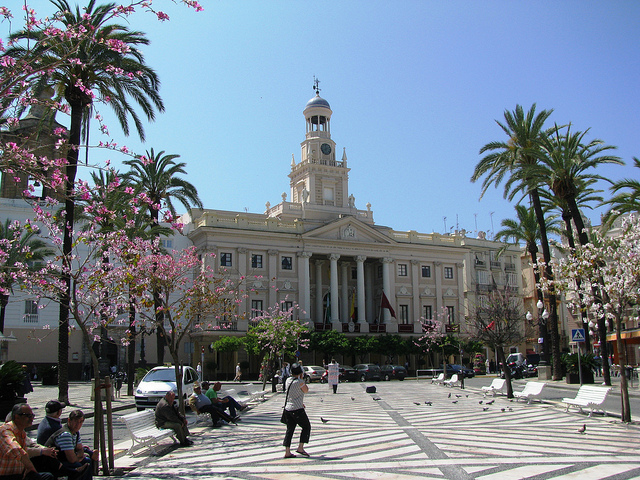
The next day we made an excursion to Cadiz, Western Europe’s oldest city which boasts a 3000 year history. Its slogan “the city that smiles” announces that Cadiz is a friendly place that also has a famous carnival. From the picturesque main square of Plaza San Juan de Dios, we walked to the massive cathedral and from there along the waterfront which often stands in for Havana’s waterfront. We also climbed the 173 steps of the Torre Tavira to enjoy an amazing view over the whole city. Then we walked to the western end of the peninsula to the scenic Parque Genoves and the Alameda Apodaca to the Plaza de Espana and checked out the Renfe Railway Station before heading back to Conil.

The waterfront in Cadiz with the Cathedral

The waterfront in Cadiz with the Cathedral

On our third day on the Costa de la Luz we took the bus from Conil to Cadiz and then the ferry from Cadiz across the bay to Puerto de Santa Maria at the mouth of the Guadalete River. Two big cruise ships were anchored in the port of Cadiz, which is a popular destination for cruise liners. The wind was extremely strong and the ferry was swaying back and forth; people on deck were getting sprayed regularly with water.

Cruise ship in the port of Cadiz

Cruise ship in the port of Cadiz

Once arrived in Puerto de Santa Maria, we started our stroll through this historic town which is part of Andalusia’s Sherry Triangle. Famous sherry bodegas like Osborne, Terry and Caballero are located here. We checked out the famous seafood tapas, the old parochial church, the 13th century castle and the bullfighting arena which dates from 1880. By 5:30 pm we were back in Cadiz and visited the fortification of San Sebastian and took a pleasant evening stroll through this animated town.

The Cathedral of Puerto de Santa Maria

The Cathedral of Puerto de Santa Maria

On April 17, 2011 we embarked on another excursion – this time to the historic hill town of Arcos de la Frontera, which was part of the frontier in Spain’s 13th century battle against the Moors. Our drive took us through green rolling hills with dozens and dozens of wind turbines – Spain is a leader in renewable energy generation. Arcos itself is located on a sandstone crag next to the Guadalete River and from various lookout points it offers majestic views over the surrounding countryside.

Arcos de la Frontera, a beautiful "pueblo blanco"

Arcos de la Frontera, a beautiful "pueblo blanco"

The Moorish street pattern consists of narrow, irregular streets and walkways; its white-washed houses usually feature interior patios that are decorated with lots of flowers. We happened to come across a Palm Sunday procession where a large group of women, dressed in white and red, were carrying a very heavy statue of the Virgin Mary, accompanied by the town’s orchestra which was playing somber tunes.

Semana Santa procession in Arcos de la Frontera

Semana Santa procession in Arcos de la Frontera

We enjoyed some tasty tapas next to the cathedral and also visited the Parador (one of the many luxury hotels run by the Spanish government) of Arcos de la Frontera before continuing our excursion to Medina Sidonia, another one of the “pueblos blancos” in the late afternoon. These white-washed villages were built by the Moors on various promontories throughout the region.

The church of Medina Sedonia

The church of Medina Sedonia

Medina Sidonia’s history actually goes back further than that as there was already a settlement in its location during Phoenician times. We walked up to the highest point in town from where we enjoyed a phenomenal view over the surrounding countryside. Then we visited the Iglesia de Santa Maria la Coronada and walked all the way up to the church tower where the wind was almost unbearable. Finally we returned to Conil where we enjoyed a relaxing evening.

An interesting plant from Medina Sedonia

An interesting plant from Medina Sedonia

Visit our website for travel advice, first-person travel stories and inspiring interviews.
Read about our 2010 adventures in Asturias in the north of Spain.
Enjoy our 2010 articles about our trip to Madrid, Salamanca and Segovia.
Here are the articles from our 2004 trip to Barcelona, Valencia and Ibiza.

Comments