Andalusia Travel: The Wonders of Seville – the Giralda, Real Alcazar, Plaza de España, the Archivo de Indias
Andalusia continued to exert its magic spell on me. After a visit to the Moorish jewel of Granada and a week of explorations along the Costa de la Luz with its pueblos blancos – the famous white-washed villages, my last day had finally arrived. In the morning we packed up all our belongings and left our rented apartment in Conil de la Frontera behind after one last breakfast in one of our favourite restaurants. My brother and sister-in-law drove me to Cadiz where I had rented a car for my next four days of discoveries in Andalusia. It was time to say goodbye after a wonderful week together as my brother and sister-in-law were heading back to Austria today. I, on the other hand, had two more destinations left in Andalusia: Seville and Cordoba.
Formerly one of Spain’s richest cities, Seville is full of impressive architecture and monuments. It is located on the banks of the River Guadalquivir and has a population of about 700,000 people with about 1.5 million residents in the metropolitan area. Today Seville is a modern city and the fourth largest city in Spain. It is more than 2000 years old and was called Hispalis by the Romans. From the 8th to the 13th century Seville was ruled by the Moors and was reconquered in 1248 by King Fernando III of Castile.
Seville’s Golden Age started with the discovery of the New World in 1492 when Christopher Columbus opened up the Spanish colonies in the Americas. All the riches from the New World arrived in Seville during the 16th and 17th century when the city had a trading monopoly for all overseas goods before they were shipped on to other places in Spain. After the River Guadalquivir silted up, its trading monopoly was broken in the late 16th century and the Great Plague hit the city in 1649, Seville experienced a steady decline and population decrease. It was not until the late 19th and early 20th century that Seville experienced a major resurgence. With this impressive history and its outstanding architecture, Seville had long been a city I had wanted to visit.
So in the late morning of April 20, 2011 I started my drive from Cadiz to Seville. I stopped about 30 km east of Seville in the picturesque town Carmona where I had booked two nights at the hotel “El Rincon de las Descalzas”, a beautiful hotel on a narrow street beside a church. I had booked my accommodation outside of Seville because during Semana Santa the hotel rooms in town were extremely expensive and I was able to stay in this hotel for less than $50.00 a night. I had a comfortable room with a private bathroom and admired the flower-filled interior courtyards of this historic property.
In the mid-afternoon I was finally ready to head into the city. I drove back west on the highway and parked my vehicle in a public parking lot next to the Santa Justa train station. From there I took a city bus into downtown Seville, but once we reached a road block the driver asked us to get out of the bus. Barriers had been put up surrounding the downtown core to keep traffic out during the famous Santa Semana processions that were taking place in Seville. I got off the bus and just a couple of minutes later I came across the first procession: countless men and boys in white robes and long pointed black hoods were walking somberly through the streets, accompanied by a marching band.
Seville is known for its Holy Week traditions, and Semana Santa is one of the busiest times in Seville. Processions commemorate the death of Jesus Christ and the pain of the Virgin Mary at the torture and killing of her son. Religious brotherhoods (hermandades or cofradias) carry life-like wooden sculptures through the street and perform public penance. Brotherhoods have been in existence since the 14th century and today there are dozens of brotherhoods that perform Roman Catholic traditions during Semana Santa.
My goal was to visit some of the most well-known sites of Seville, including the Giralda. But the layout of downtown Seville with its narrow and confusing street patterns had me ask the locals about five times before I found Seville’s most well-known landmark. The Giralda is the belltower of the Cathedral of Seville, a former minaret whose construction was started in 1184. After the reconquest of Seville from the Moors in 1248, the city’s mosque was turned into a church, and Gothic and Baroque elements were added to the tower. During the Renaissance it was expanded. The Giralda has become the inspiration for many other towers across the world, including the Ferry Building in San Francisco and the Biltmore Hotel in Miami.
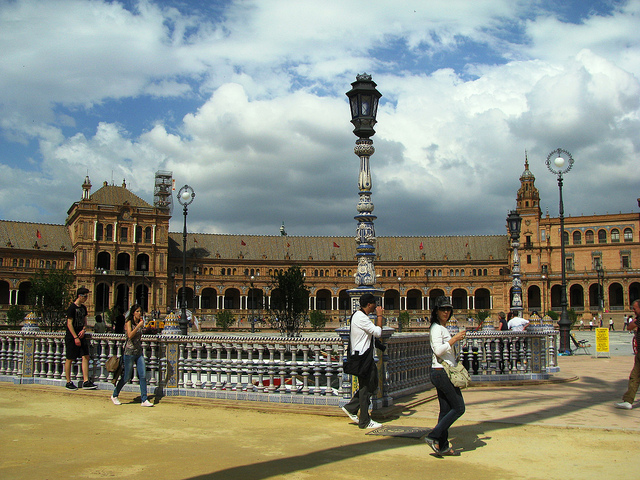
There was a huge lineup in front of the cathedral, so I decided to explore the winding streets of the Barrio de Santa Cruz – Seville’s former Jewish quarter. The narrow streets hold cozy restaurants, bistros and souvenir shops. From the Barrio de Santa Cruz I then walked to the Plaza de España, the site of the Spanish pavilion that was built for the 1929 Ibero-American World Fair. Located inside Maria Luisa Park, this large complex is a mix of Renaissance Revival, Art Deco and Neo-Mudejar styles. In front of a huge half-circle of buildings is a large moat with attractive bridges. Today the Plaza de España houses a variety of government offices while it is also hugely popular with the tourists.
Towards the late afternoon I hopped on one of the double-decker sightseeing buses to get to know the city better. We started with the Triana neighbourhood across the river, a traditional working class area that is famous for its bull fighters and flamenco. We continued our way through the grounds of Expo 1992 which attracted almost 42 million visitors and put Seville on the map.
Back on the east side of the Guadalquivir River we also drove by the Maestranza, the oldest bullring of Spain whose construction started in 1749. Just a few hundred meters further south was passed by the Torre de Oro, a twelve-sided military watchtower that was built in the early 1200s as a defensive lookout.
As it started to rain I drove back to spend a cozy night in Carmona and rest up for my second day of explorations in Seville. The next morning, Good Friday, I actually managed to find parking next to the Guadalquivir River and had breakfast inside the former Seville Railway Station which has been turned into a shopping centre with several restaurants and cafes. The streets were eerily quiet and the sky was darkening. Rain was definitely in the forecast for April 21, 2011. Unfortunately this meant that the Semana Santa processions would be cancelled for today.
After a stroll past the Cathedral I visited one of the UNESCO World Heritage Sites of Seville: the Archivo de Indias. Housed in the former merchants exchange, this impressive building is home to extremely valuable archival documents about the history of the Spanish Empire in its overseas possessions. Started in 1572, the building features a large central patio and holds about 80 million pages of historic documents.
Across the Plaza del Triunfo is the Real Alcázar, the Royal Palace of Seville. A visit to this palace would be the perfect program for a rainy afternoon. The royal residence was created inside the palaces that had had been built by the Almohades, a Berber-Muslim dynasty, during the 12th century. The palace has numerous unique and fascinating areas, including the Patio de las Doncellas with its intricate plasterwork, and the Salon de Embajadores which boasts a magnificent dome of carved and gilded wood – just a breathtaking space.
Many attractive interior courtyards make up the complex and rooms are decorated with beautiful azulejos (traditional Spanish tiles) and complex plasterwork. With their terraces, fountains and pavilions, the Gardens of the Alcázar are equally impressive and provide a green oasis in the heart of Seville.
As the light drizzle continued, I left the palace, crossed the scenic Jewish Quarter and had a late lunch at an Italian restaurant before capping off my sightseeing in Seville with another visit to the stunning Plaza de Espana. In the evening I explored the historic town of Carmona.
Built on a ridge about 33 km north-east of Seville, Carmona was already an important town during Roman times. The Moors created the dense downtown area with narrow, winding and cobblestoned streets. The Alcázar del Rey Pedro has been turned into a parador, a luxury hotel, that offers a gorgeous view from the hilltop. As the locals were leaving the churches after evening mass, I strolled through the narrow streets of downtown Carmona and took in the warm ambience of this medieval town before heading to bed and rest up for my last two days in Andalusia. Two more days in Cordoba were waiting for me…
Related Articles:
Europe 2011: Andalusia Travel – Granada & the Alhambra
Europe 2011: Andalusia Travel – Costa de la Luz, Cadiz & the Pueblos Blancos
Europe 2011: Andalusia Travel – the Wonders of Seville
Europe 2011: Andalusia Travel – Cordoba and the Mezquita
Europe 2011: Austria Travel – Four Days in my Home Country
Europe 2011: Reflections on Berlin
Please visit our website for more travel advice, first-hand travel stories and inspiring interviews.
Here is our article about our 2011 explorations in Granada.
Check out our article about our 2011 explorations on the Costa de la Luz.
Here is our article series about our 2010 trip to Asturias.
Please have a look at our articles from our trip to Madrid, Segovia and Salamanca.
Here is our article collection from our 2009 trip to Mallorca.
Please check the articles for our 2004 trip to Spain.
Have a look at some of our 2011 videos from Andalusia.


October 26th, 2011 at 2:33 am
This article was really good. I look forward to reading another one.
November 13th, 2011 at 6:28 pm
great to meet you http://www.travelandtransitions.com admin found your website via search engine Take care. Jay